Death conditioning
Brave New WorldDeath conditioning is the World State’s program for teaching children to accept death without fear or grief. It begins in infancy and joins emotional training to a carefully arranged hospital routine: children encounter dying people, receive appealing distractions, and are taught to regard death as an ordinary bodily process. The practice makes private bereavement a public problem, as the response to Linda’s death shows how thoroughly the system privileges social composure over mourning.
Purpose and Method
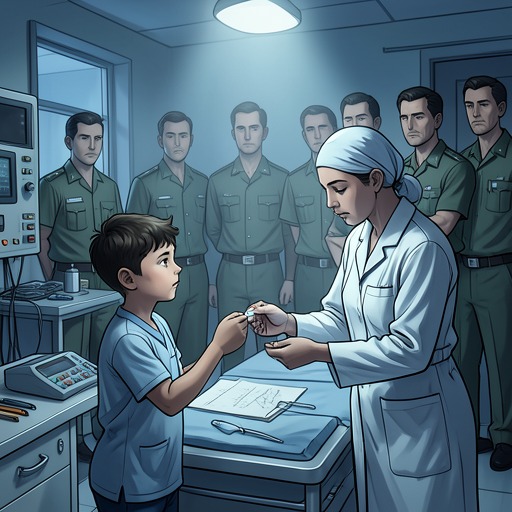
At Eton, Dr. Gaffney explains that death conditioning begins when children are eighteen months old. Each child spends two mornings a week at a Hospital for the Dying, where the best toys are kept and chocolate cream is served on death days. The Head Mistress describes the lesson as learning to take dying as a matter of course, while another educator compares death to any other physiological process. The arrangement does not merely explain death: it associates the hospital with routine visits and treats, making the setting part of the lesson.
The policy belongs to a wider effort to make emotional life predictable. The Controller argues that social stability depends on stable individuals, and describes the civilization’s goal as preserving people, as far as possible, from having emotions at all. His account presents strong feeling as something that can overflow when desire is delayed; the system instead seeks to remove those intervals and barriers. Death conditioning applies that logic to mortality: children are trained not to let death become an occasion for prolonged or disruptive feeling.
The Lesson in Practice
At the Hospital for the Dying, children returning from the Slough Crematorium arrive in five busloads. Their orderly visit is one part of the curriculum, not an exceptional encounter. The regular schedule, familiar toys, and chocolate cream make contact with death compatible with ordinary institutional routine. In this way, the program addresses not only what children know about death but also the reactions they are encouraged to have around it.
The policy’s consequences become plain when Linda dies in Bed 20. John grieves beside her, while the children stop their game and stare. The nurse sees his mourning as a danger to their conditioning: if they witness grief, she fears, they may form the idea that death is terrible or that one person matters enough to warrant such a response. She considers the possibility that the children’s conditioning could be set back by months. Rather than address John’s loss, she offers the children chocolate eclairs; the Bokanovsky Group responds together, and Bed 20 is forgotten.
Social Function and Limits
Death conditioning is presented as one component of a society organized around stability and the management of feeling. The Controller’s account of social order links individual steadiness to the continued operation of society, while the hospital episode shows the practical enforcement of that ideal: even grief is assessed by whether it might disrupt the group’s training. Children are not simply taught that death occurs; they are trained to keep it from becoming emotionally consequential.
The contrast with John’s response exposes the limits of the lesson. When Linda dies, he mourns, and the children’s attention briefly turns from their game to the event. The nurse redirects them with a treat, restoring the routine but not answering the grief beside the bed. The scene makes the program’s achievement and its cost visible at once: it can recover the group’s practiced cheerfulness, but it does so by making an individual’s loss disappear from view.